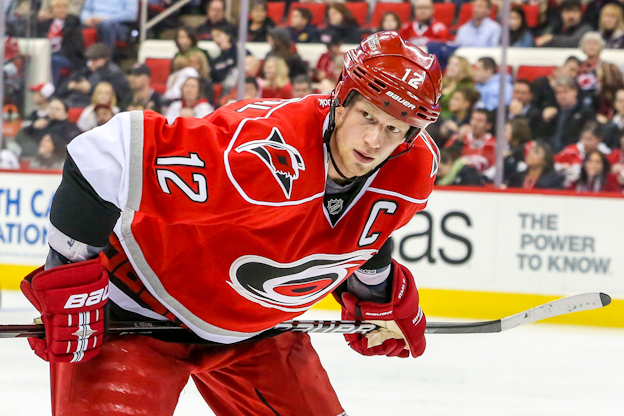
The Carolina Hurricanes have spent the summer celebrating after winning the Stanley Cup in June. The trophy has changed all the talk around the franchise. Faux narratives about being soft and choking were convincingly dismissed with a 16-3 run to hockey’s Holy Grail. However, one question remains: can they overcome the best of the best between the pipes?
Carolina’s History of Getting Goalied
Since Rod Brind’Amour became head coach at the beginning of the 2018-19 season, the Hurricanes have lost to four teams in the playoffs: the Boston Bruins, Tampa Bay Lightning, New York Rangers, and Florida Panthers. The one thing they all had in common: elite goaltending. This isn’t to say they weren’t talented squads, but teams like the New Jersey Devils, whom the Hurricanes routinely dispatch from the playoff picture, are also immensely talented.
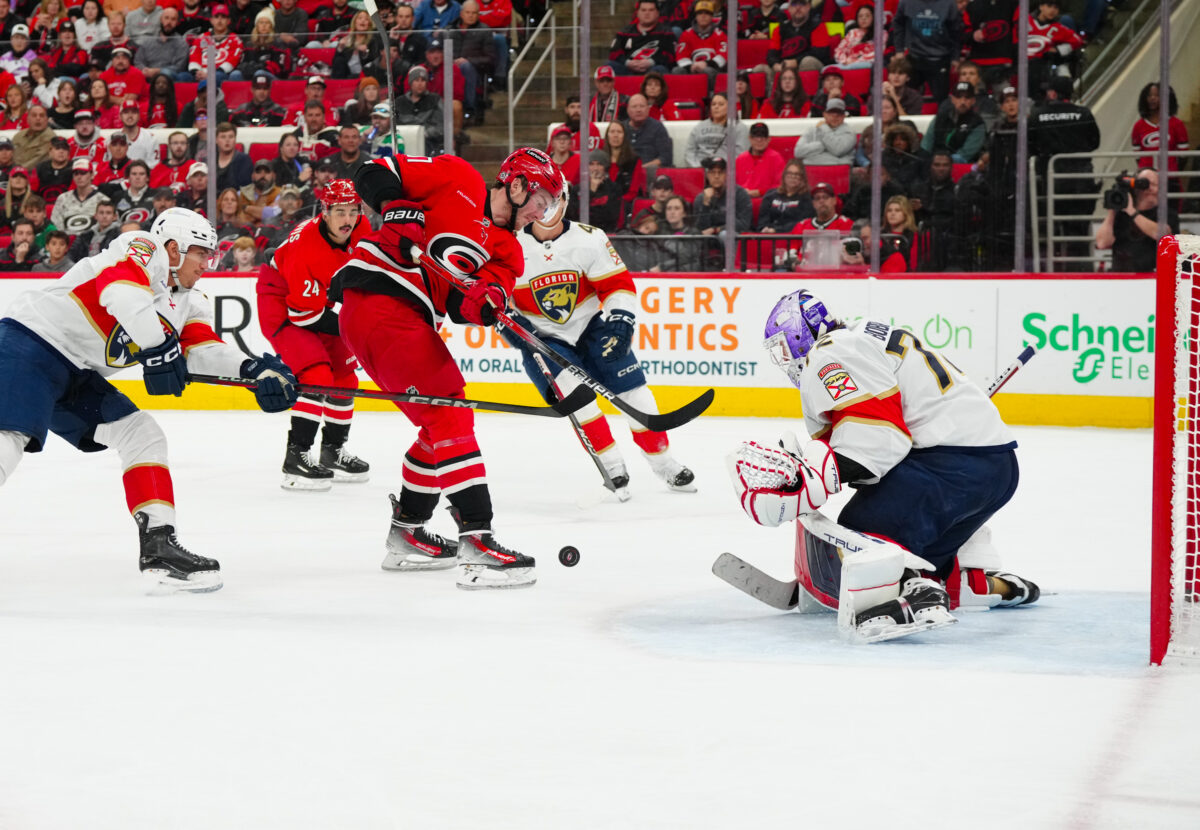
The four goalies in question are Tuukka Rask, Andrei Vasilevskiy, Igor Shesterkin, and Sergei Bobrovsky, respectively. These are the only four goaltenders to have beaten the Hurricanes in the playoffs in the last decade. These were all, at worst, top 5-7 goaltenders in the NHL when they ousted Carolina, who struggled to defeat their skill.
Carolina’s Struggles Against Elite Goaltenders
The Hurricanes have played in 21 playoff series since 2018-19, including the 2020 play-in, and they’ve won rounds in every season they’ve made the dance. They have played deep, physical, highly skilled, aggressive, and well-rounded teams, and beaten them all. The very first playoff round they won under Brind’Amour dethroned the reigning Stanley Cup Champion Washington Capitals. So where do the problems originate?
It comes from the system the Hurricanes employ offensively. They depend on shot volume over quality. Even in the 2026 Playoffs, they ranked second in Corsi (shot attempts) per 60 minutes, with 66.05 shot attempts per 60 minutes, according to Natural Stat Trick.
The problem is where the shots are taken from. According to NHL Edge, the Hurricanes had 601 shots on goal in the postseason, but only 163 were from high-danger areas. That’s a hair over 27%. For comparison, the Vegas Golden Knights, who Carolina defeated in the Stanley Cup Final, took 30% of their shots from high-danger areas.
Carolina relies heavily on its shoot-from-everywhere mantra. Often, the best high-danger chances they get come from scrambles for loose pucks and rebounds rather than creativity. Against average goalies, the number of shots becomes overwhelming.
The logic is that the NHL is the equivalent of an infinite number of monkeys at an infinite number of typewriters eventually producing War and Peace; an infinite number of shots will eventually create rebound chances that are more dangerous than normal ones. That or a lucky bounce hits a skate and drops in front, or a screen the goalie can’t see through makes him lose track of the puck, and it goes clean in.
So, what’s different? Simply put, the trouble is bona fide elite netminders. At least two of the four who have defeated Carolina are likely destined for the Hockey Hall of Fame. These goalies are perfectly happy to handle the heavy workload when facing the Hurricanes, and it often makes them sharper as the series goes on. The team has this nasty habit of turning elite goalies into hot elite goalies because they get used to stopping Carolina’s low-danger chances and begin to see the puck like it’s a beach ball.
Rask
Rask was the first goalie to dispatch a Brind’Amour-led roster in 2018-19. After overcoming Brayden Holtby and the defending Cup champion Capitals, followed by Robin Lehner and the New York Islanders, the Hurricanes were red hot going into the third-round series against the Bruins.
Rask gave up just 5 goals on 109 shots for a .956 save percentage. He gave up just 17 rebound attempts. His rebound control was exquisite, and a tired Canes team were put out of their misery by the Bruins. However, it was the first time the Hurricanes had made the playoffs in a decade, so we could be forgiven for thinking it was a fluke at the time.
Vasilevskiy
The 2021 Round 2 series is often forgotten, since the Lightning swatted away what was still a relatively inexperienced Hurricanes group in five games. This is probably the series that proved most clearly that elite goaltending was an issue for Carolina.
Vasilevskiy had a .940 save percentage, stopping 142 of the 151 shots. He also gave up just 21 rebound attempts. This was a particularly frustrating series because he seemed to trap every shot from distance, either between his pads or under his glove, which killed the Hurricanes’ offensive momentum so regularly that they never really got going. Carolina had no answer for the Bolts’ big Russian.
Shesterkin
It could be argued that the Lightning were (are) an elite team and better than Carolina. It’s a genuinely fair argument. So let’s look at Shesterkin, a goalie who has shut down the Hurricanes in brutal fashion twice in the postseason.
In 2022, the Rangers defeated the Canes in seven games, clinching the series in Raleigh. Carolina averaged 32 shots a game. Shesterkin gave up just 12 goals on 222 shots for a save percentage of .949. Why? The Hurricanes had 48 rebound attempts in the series. That’s suffocating for an offence desperate for the secondary chance rather than the primary shot to go in.

Ironically, in the 2024 rematch, Shesterkin looked more human, earning a .919 save percentage and stopping 121 of 129 shots. His rebound control wasn’t great, giving up 43 rebound attempts, and his save percentage plummeted. The Hurricanes still lost in six games. This is perhaps the one example of the team getting the matchup they want against a goaltender and struggling to exploit it because other areas of the roster aren’t working.
Bobrovsky
When the Panthers swept the Hurricanes in the 2023 Eastern Conference Final (ECF), Bobrovsky faced 174 shots. That’s 43.5 shots per game. He gave up six goals and posted a shutout in Game 3. He gave up 36 rebound attempts; that sounds like a lot, but they were not all on target. Kicking a puck that is shot into the side of the net into a corner was a rebound attempt, even if it wasn’t dangerous. That’s the problem the Hurricanes created for themselves.
In the 2025 ECF series, Bobrovsky faced 124 shots through five games. That’s 24.8 shots a game. But he allowed only eight goals and just 26 rebound attempts against. His rebound control is why the shot totals in this series are abnormally low for Carolina. He negated the secondary threat by neutralising the initial shot, either controlling it or kicking it somewhere that forced the Hurricanes onto the forecheck to retrieve it.
Playoff Rematches
All of these stats are meaningless if we cannot separate the goalie’s success from the team’s. The Panthers might have the Hurricanes’ number, or it could be Bobrovsky. We won’t know until there’s another series between them. That’s the case for most of these situations, but not all of them. In 2022, the first-round series between the Bruins and Hurricanes did not feature Rask, and the outcome was different.
The Hurricanes won the seven-game series while the bulk of the Bruins’ core that had dismantled the Hurricanes a few years before was still on the roster. The depth was different, sure, and it was also an unusual season because every team in the Eastern Conference who made the playoffs had hit the 100-point mark, which highlights just how good Boston was.
Carolina scored eight goals in the first two games against Linus Ullmark, ousting him from the series. The Bruins brought in Jeremy Swayman, who faced 133 of the 146 shots in the series, giving up 27 rebound chances in five games.
That’s comparable to Bobrovsky, but in this case, the Bruins were chasing the series. Carolina only had to win two games after Swayman got in. It wasn’t easy, but they did it. Theoretically, Swayman is the kind of goalie capable of beating Carolina; he just didn’t.
Why Didn’t It Impact Their 2026 Championship
The Hurricanes played against Ullmark, Dan Vladar, Jakub Dobes, and Carter Hart in the 2026 Playoffs. Hart became the first goaltender in Stanley Cup Final history to allow four goals in each of the first five games of a series. That’s not the mark of a top-tier goaltender, and the debate about whether he should have been given the chance to stay in the series will be examined for many years to come. He’s not the elite goaltender the Hurricanes have historically struggled to overcome in the postseason.
Dobes and Vladar are the hopes for the future on their teams, but they aren’t yet regulars in the Vezina conversation. They’re capable of masterful performances; both backstopped their teams deeper into the postseason than they had been recently. However, playing at an elite level is vastly different from playing consistently at a high level.
Ullmark played extremely well overall in the first-round series, but again, rebound chances sank him and, eventually, the Ottawa Senators. His 34 rebound chances in four games, even if one went to double overtime, won’t cut it against a team built to get to the loose puck in front of the net. Ullmark was the closest to the four monsters of the past that Carolina faced as a former Vezina Trophy winner and the league’s best netminder, but there’s still a gap between him and the Hurricanes’ struggles against elite goaltending.
This isn’t to say there should be a caveat on Carolina’s championship; you play whoever is in front of you, and a 16-3 record indicates a team that trucked through the league. The Hurricanes should be a playoff force again in 2026-27, which may give them the chance to win again and put all the questions about them to rest, once and for all.
Free Newsletter
Get Carolina Hurricanes coverage delivered to your inbox
In-depth analysis, breaking news, and insider takes - free.
Subscribe Free →