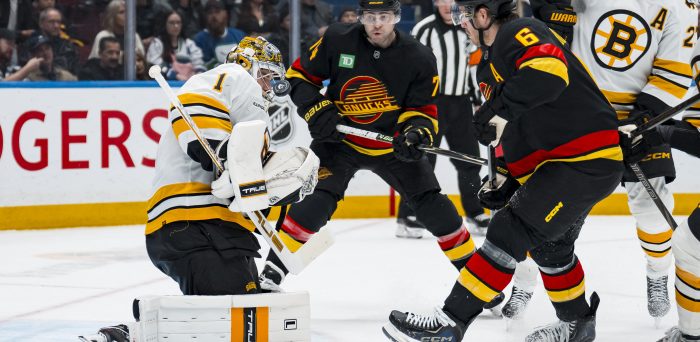
The Vancouver Canucks are not making a splash so much as they are stitching together roles, habits, and redundancies. In their latest set of moves, they have made it pretty clear how the leadership group thinks their team should be built over the long haul and which on-ice leaders should be part of that process. Think of their moves as building structure.
Over the span of two days, Vancouver has added size on the back end, insurance at centre ice, and a familiar veteran presence to stabilize the blue line. Jamie Oleksiak arrived first, Matthew Stienburg followed as organizational depth, and Luke Schenn returns to a familiar sweater. Taken together, the pattern is difficult to miss, even if the long-term picture still invites questions.
Jamie Oleksiak: Size, Structure, and a Clear Defensive Identity
The most immediate and consequential move was signing Jamie Oleksiak to a two-year, $10 million contract. It speaks less about upside and more about clarity. After moving Marcus Pettersson to the New York Rangers, the Canucks were not simply replacing a player; they were replacing a function.
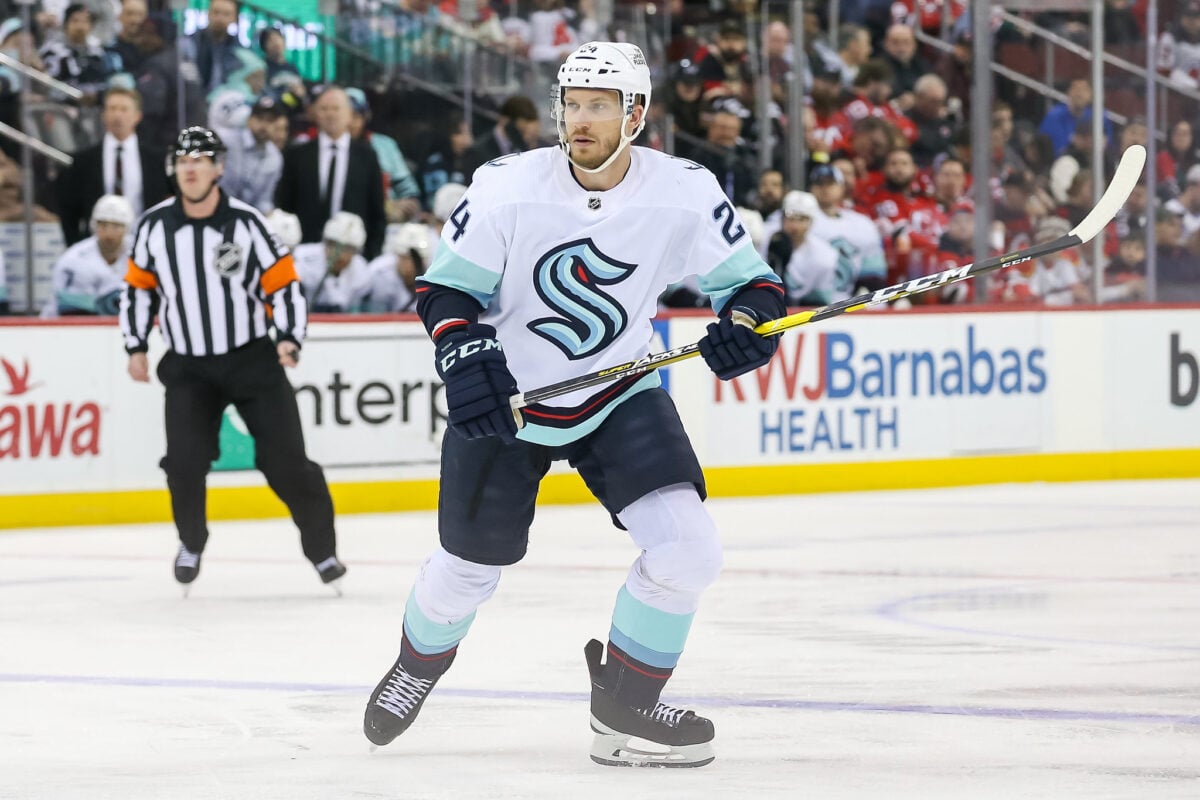
Oleksiak brings a very specific kind of game. Over five seasons with the Seattle Kraken, he became a reliable shutdown defender who does not drift from simplicity. Last year, across 78 games, he posted five goals and 15 points, along with 112 hits, 106 blocked shots, and a plus-9 rating. The offensive output is modest, but that is not the currency in which he trades.
What Vancouver is buying is reach, structure, and penalty-killing stability. At 6-foot-7, Oleksiak changes the geometry of defensive-zone exits simply by occupying space. He is not Pettersson in terms of puck movement, but the Canucks are prioritizing predictability over creativity in certain matchups, particularly working to help the young players who drive their transition game.
In that sense, Oleksiak is less a replacement and more a reallocation of defensive responsibility. He is there to absorb minutes, blunt pressure, and make the game simpler for the young players around him.
Matthew Stienburg: Depth Without Illusion
If Oleksiak represents the NHL layer of the structure, Matthew Stienburg is a young centre who serves as the organizational insurance policy. Signed to a one-year, two-way contract, Stienburg arrives not as a projected roster fixture, but as a reminder of how thin depth can become over an 82-game season.

His path has been uneven. After making his NHL debut with the Colorado Avalanche in 2024-25, appearing in eight games, Stienburg spent the following season largely in the American Hockey League (AHL). Injuries limited him to just eight appearances with the Colorado Eagles in 2025-26, where he scored two goals and one assist.
There is no attempt here to oversell his trajectory. The Canucks are not bringing him in as a solution, but as a possibility. The expectation is that he begins with the AHL’s Abbotsford Canucks, works through health and consistency issues, and re-establishes himself as a call-up option when injuries inevitably reshape the NHL roster.
Luke Schenn: Familiarity, Physicality, and Predictability
Then there is Luke Schenn, who needs little introduction. His one-year, $2.25 million return is not a bet on development. It is a bet on memory, role certainty, and dressing-room familiarity. Schenn split last season between the Winnipeg Jets and Buffalo Sabres, playing 50 games and contributing in the most traditional sense of his career: 149 hits, 57 blocked shots, and a defensive posture that requires no interpretation. The offence remains minimal, but that has never been the point.
At 36, Schenn’s value lies in reliability within defined parameters. He is expected to slot into the third pairing, stabilize penalty-kill rotations, and provide a physical presence that can be deployed without hesitation. There is comfort in that predictability, especially for a team that has oscillated between structured defensive play and high-event transitions.

His return also signals something subtler. The Canucks are not attempting to reinvent their defensive identity in a single sweep. Like Oleksiak, Schenn is there as the transitional glue that helps reinforce familiar edges while trying to tighten execution in the middle. He brings calmness, structure, and experience to a young group.
What’s Next for the Canucks?
Taken individually, each of these moves is defensible. Taken together, they form a clearer philosophical picture. The Canucks are prioritizing structure, size, and experience over variability and offensive upside in their depth chart. In short, they are working to build a safety net around their youngsters. That approach has merit, particularly for a team trying to stabilize its defence around a group of young players with significant upside who still need space to grow. I fully understand the process.
Free Newsletter
Get Vancouver Canucks coverage delivered to your inbox
In-depth analysis, breaking news, and insider takes - free.
Subscribe Free →