The Edmonton Oilers’ aggressive offseason created new opportunities throughout the roster, but it also increased the pressure surrounding several players entering 2026-27.
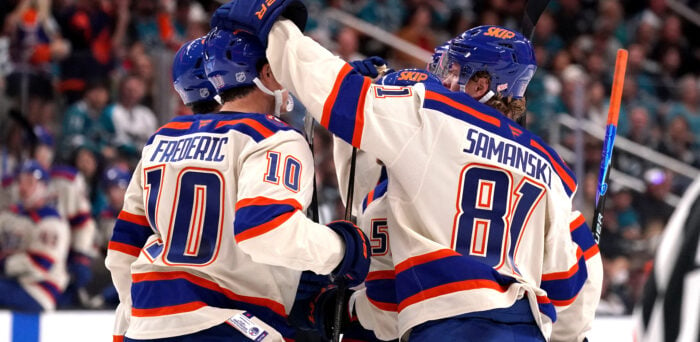
Tristan Jarry must recover from a disastrous finish to his first season in Edmonton while competing with Frederik Andersen and Devon Levi for playing time. Trent Frederic needs to begin justifying the eight-year contract he signed in 2025 after producing only seven points last season. Ryan Shea must prove his breakout performance with the Pittsburgh Penguins was sustainable after Edmonton committed $20 million to him as part of its reconstructed defense.
Each player faces a different form of pressure. Jarry is attempting to restore confidence, Frederic must show he can still provide meaningful bottom-six production, and Shea is being asked to turn one exceptional season into a reliable long-term role.
Their performances will help determine whether Edmonton’s offseason overhaul provided legitimate solutions or simply replaced its previous concerns with new ones.
1. Ryan Shea Must Prove Breakout Was Sustainable
Shea earned his opportunity with Edmonton by producing the best season of his professional career at the ideal time.
After recording only six total points across his first 70 NHL appearances, Shea broke out with six goals and 35 points in 80 games for Pittsburgh during 2025-26. He finished with a plus-30 rating while averaging 18:53 of ice time and contributing regularly on the penalty kill.
Those results helped Shea secure a five-year, $20 million contract with the Oilers on July 1. His $4 million annual cap hit represents a significant increase from the $900,000 contract he played under last season.
The signing also came on the same day Edmonton traded Darnell Nurse to the San Jose Sharks. The Oilers received Shakir Mukhamadullin and Zack Sharp in the transaction, but the NHL’s report on the Nurse trade identified Shea as one of Edmonton’s primary additions intended to help replace the longtime defenceman.
Shea should not be expected to become a direct replacement for Nurse. He does not bring the same physicality, established top-four workload or history of handling difficult matchups against elite forwards. Edmonton does need him to become more than a depth defenceman who benefited from one unusually productive season.
Shea’s offensive breakout was substantial. His 29 assists ranked fourth among Penguins players, while his complete 2025-26 statistics showed that he finished the season ahead of several more established Pittsburgh defencemen in scoring and plus-minus.
The concern is that Shea had never approached that level before. He recorded one point in 31 games as an NHL rookie in 2023-24 and five points in 39 appearances the following season. His jump to 35 points therefore represented more than gradual improvement.
Some regression should be expected, particularly if Shea receives less offensive freedom or plays behind Evan Bouchard and Mattias Ekholm in Edmonton. He does not need another 35-point season to justify the contract. He must show that the decision-making, puck movement and defensive consistency behind the breakout can transfer to a new team.
Shea described the five-year agreement as the result of repeatedly betting on himself through shorter contracts. He also said he intended to arrive at camp ready to demonstrate that he was “not messing around” after joining an established Stanley Cup contender.
That mindset will be necessary. Edmonton has committed to Shea through 2030-31 despite possessing only one full season of evidence that he can consistently handle a major NHL role.
If Shea settles into the second or third pairing, moves the puck efficiently and contributes on the penalty kill, the signing could become one of Edmonton’s smartest offseason decisions. If his Pittsburgh season proves to be an outlier, the Oilers will have another lengthy contract attached to an uncertain defenceman.
2. Trent Frederic Must Begin Justifying 8-Year Contract
Frederic enters the season facing a different problem. Unlike Shea, he has already completed the first year of his long-term agreement, and the initial results were alarming.
The Oilers signed Frederic to an eight-year, $30.8 million extension in June 2025. The $3.85 million cap hit was designed to reduce the annual cost in exchange for Edmonton accepting the risk of maximum term.
General manager Stan Bowman believed Frederic’s size, physicality and versatility could make him a valuable supporting forward throughout the contract. The Oilers had only received a limited look at him after acquiring him while he was recovering from a high-ankle sprain, but they committed before he reached unrestricted free agency.
Frederic’s first season under the agreement provided almost none of the value Edmonton expected. He recorded four goals and three assists in 74 games, finishing with a minus-15 rating while averaging 11:02 of ice time. His official Oilers statistics also show that he converted only 5.2% of his 77 shots.
Those numbers were dramatically below the production Frederic demonstrated during his best seasons with the Boston Bruins. He established career highs with 18 goals and 40 points in 2023-24 after recording 17 goals and 31 points the previous year.
Edmonton does not need Frederic to become a 40-point scorer. It cannot afford another season in which he provides seven points while occupying a permanent place in the bottom six.
His 2025-26 Oilers report card argued that he had become a fourth-line player despite being paid and signed like a more important contributor. That assessment captures the pressure entering the second year of the agreement.
Frederic must restore the identity that made him useful in Boston. He is at his best when he forechecks aggressively, finishes checks, protects possession and contributes enough offence to keep a third line from becoming one-dimensional.
The Oilers did not sign him for pure scoring, but physical play cannot completely excuse the lack of production. Edmonton needs its bottom six to support Connor McDavid and Leon Draisaitl rather than forcing the stars to decide every game.

Frederic should receive opportunities under new head coach Mike Babcock because his size and direct style fit the type of structured, difficult-to-play-against lineup Edmonton wants to build. The question is whether a new system can unlock the confidence and offensive involvement that disappeared last season.
One rebound season would not completely validate an eight-year contract. It would at least make the agreement look more manageable. Another single-digit point total would turn concern into a long-term organizational problem.
3. Tristan Jarry Must Rebuild Trust in Crowded Crease
No Oilers player enters 2026-27 with more to prove than Tristan Jarry.
Edmonton acquired Jarry and Samuel Poulin from Pittsburgh in December 2025 in exchange for Stuart Skinner, Brett Kulak and a 2029 second-round pick. The transaction represented a major bet that Jarry could provide more stable goaltending than Skinner during the remaining championship window.
His first 19 appearances did the opposite. Jarry finished his Edmonton portion of the season with a 3.86 goals-against average (GAA) and an .858 save percentage (SV%). He allowed 62 goals on 436 shots and struggled to establish any sustained momentum after arriving.
The results were particularly disappointing because Jarry had played well before the trade. He had regained Pittsburgh’s starting job and entered Edmonton with a 9-3-1 record through 14 appearances.
The contrast made his collapse more difficult to explain. Jarry still has two seasons remaining on a contract carrying a $5.375 million annual cap hit. His 2025-26 Oilers report card gave him a D grade and concluded that the bad moments significantly outweighed the occasional strong performances.
Edmonton responded by creating genuine competition around him. The Oilers signed Andersen to a one-year, $2.8 million contract after the veteran went 13-2 with a 1.89 GAA and .913 SV% during Carolina’s Stanley Cup run. They also acquired Levi from the Buffalo Sabres for a package that included a 2028 third-round pick.
Andersen brings experience and recent postseason success. Levi offers youth and development potential. Jarry carries the largest cap hit and possesses the most experience handling a regular-season starter’s workload. That does not guarantee him the opening-night job.
The Oilers could begin the season with all three goaltenders on the roster, creating a rotation in which every poor start affects the distribution of future appearances. THW’s look at the Oilers’ five biggest questions entering the season identified Jarry’s ability to bounce back as one of the roster’s defining issues.
Jarry does not need to become a Vezina Trophy contender. Edmonton needs competent, predictable goaltending that prevents routine mistakes from erasing the advantages created by its elite forwards.
His previous NHL results suggest that outcome remains possible. Jarry is a two-time All-Star who has recorded five seasons with a SV% of at least .909. He has shown the technical ability and athleticism required to carry a substantial workload.
The concern is reliability. Jarry’s career has included injuries, extended stretches of inconsistent play and high-profile mistakes. His poor finish in Edmonton reinforced the doubts that followed him from Pittsburgh rather than providing a fresh start. He now has fewer excuses and more competition.
Andersen can take over important games if Jarry struggles. Levi needs NHL opportunities to continue developing. Edmonton is no longer structured around waiting indefinitely for Jarry to rediscover his best form.
That pressure could help him. Jarry performed well early last season when he was forced to reclaim Pittsburgh’s net, showing that competition can produce a more focused version of his game.
It could also reduce his role quickly. A strong beginning would allow Jarry to reestablish himself as the primary starter while Edmonton manages Andersen’s workload and introduces Levi gradually. Another poor stretch could move him from a hoped-for solution to an expensive third option.
Jarry’s Performance Will Have Greatest Impact
Shea and Frederic carry longer contracts, but Jarry’s performance will have the greatest immediate effect on Edmonton’s season. Shea can justify his contract by becoming a steady middle-pair defenceman even if his scoring declines. Frederic can rebuild some value by returning to double-digit goals and providing reliable physical play in the bottom six. Jarry plays the position most capable of determining Edmonton’s postseason outcome.

The Oilers have spent several seasons trying to stabilize their crease while possessing one of the NHL’s most talented cores. Their decision to trade Skinner and Kulak for Jarry only increased the importance of finding a dependable answer.
Andersen gives Edmonton protection, but the 36-year-old has dealt with injuries and should not be expected to carry an exhausting regular-season workload. Levi may eventually become the long-term solution, but he remains an unproven NHL goaltender.
The best version of Edmonton’s plan still involves Jarry recovering. If he returns to his previous form, Andersen can remain fresh and Levi can develop without being forced into a role he has not earned. If Jarry struggles again, the Oilers will be relying on an aging veteran and an inexperienced alternative while carrying a $5.375 million cap hit for a goaltender they cannot trust.
Shea and Frederic must prove Edmonton’s contract decisions were defensible. Jarry must prove the Oilers did not miscalculate at the most important position on the roster. That makes him the player with the most at stake entering 2026-27.
Free Newsletter
Get Edmonton Oilers coverage delivered to your inbox
In-depth analysis, breaking news, and insider takes - free.
Subscribe Free →