At the start of the summer of 1988, the Edmonton Oilers were on top of the world. They had just won their fourth Stanley Cup in five years, and with a roster that included five future Hall of Famers between the ages of 25 and 29, Edmonton appeared destined to dominate the NHL for years to come, even perhaps becoming the league’s greatest dynasty.
But just a couple of months before the 1988-89 season, the Oilers were rocked at their foundation when beloved superstar captain Wayne Gretzky was dealt to the Los Angeles Kings in a shocking trade that saw Edmonton receive forward Jimmy Carson as the principal return.
The trade also saw veterans Mike Krushelnyski and Marty McSorely sent to Los Angeles, while Edmonton additionally acquired forward Martin Gelinas, three future first-round picks in the NHL Entry Draft, and (infamously) cash.
Under the pall cast by Gretzky’s departure, Edmonton middled through the 1988-89 regular season, finishing with its lowest point total in eight years. Then the Oilers were eliminated in the first round of the Stanley Cup Playoffs, their earliest exit in seven years, by none other than Gretzky and the Kings.
Within a year, Edmonton had gone from an unstoppable juggernaut to a team that many doubted would even win another championship. Things were going to get worse: after only four games into Edmonton’s 1989-90 schedule, Carson left the team and demanded a trade.
It was another blow to a team that had already been knocked off course. But it turned out to be the ultimate blessing in disguise.
Carson’s Year in Edmonton
Carson was less than three weeks removed from his 20th birthday when he was traded to the Oilers in exchange for the greatest player in hockey history on Aug. 9, 1988.
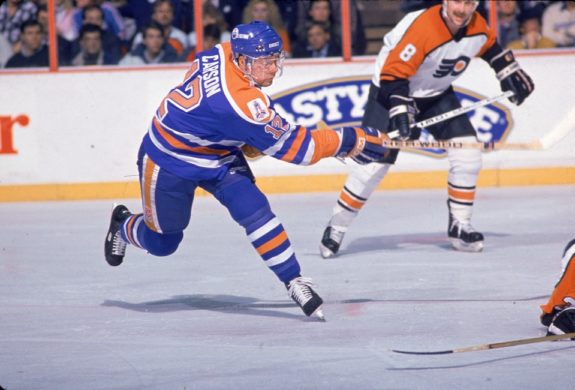
The second overall pick in the 1986 NHL Draft, Carson got off to a very impressive start to his NHL career, totalling 79 points in 1986-87 and 107 points in 1987-88. He scored 92 times over his first two seasons, setting the NHL record for most goals by a player as a teenager.
Statistically, Carson had a great season for the Oilers in 1988-89. He led Edmonton and tied for seventh in the NHL with 49 goals, while his 100 points ranked second on the Oilers and ninth in the league. Carson was also named to the Campbell Conference roster for the 1989 NHL All-Star Game.
But the Southfield, Mich., product couldn’t escape the cloud of being “the guy who was traded for Gretzky.” He never felt comfortable in Edmonton, and that boiled over early in his second season as an Oiler.
Carson Leaves Oilers
News broke on Oct. 14, 1989, that Carson had departed Edmonton and gone to his house in Los Angeles. Less than 24 hours earlier, Carson was in the Oilers’ lineup for their 3-3 tie with the Boston Bruins at Northlands Coliseum but was benched during the third period by head coach John Muckler, who said “there was no life, no try” in the forward. (From ‘Oilers Shocked as Carson Quits,’ Edmonton Journal, 10/15/89).
Carson’s agent, Bill Watters, told the Edmonton Journal: “He’s had it. The party’s over. He’s not playing well, and he feels like if he’s going to play in Edmonton like he has the last while, then ‘to hell with it.'”
Ironically, this all went down on the day before the Oilers hosted the Kings, in a historic game that saw Gretzky set the NHL’s all-time points record.
“I don’t understand what he’s trying to pull off,” Oilers general manager Glen Sather told the Edmonton Journal. “But I’m not doing anything that will hurt this club. I notified all the teams he’d left and to call if they were interested. I won’t say when I’ll trade him. Who knows, if I got the right kind of offer, I might trade him right away. If I don’t, well, we’ll wait and see.”
It took nearly three weeks before Sather got the right offer. On Nov. 2, 1989, Edmonton’s general manager dealt Carson, veteran forward Kevin McClelland and a fifth-round pick in the 1991 Draft to the Detroit Red Wings. In return, the Oilers received forwards Adam Graves, Petr Klima, and Joe Murphy, along with defenceman Jeff Sharples.
Oilers’ Championship Run
At the time of the trade, the Oilers had a record of 4-5-4 for 12 points, tied for the third-fewest in the Campbell Conference. From Nov. 3 to the end of the regular season, Edmonton went 34-23-10, amassing the second-most points in the conference over that span as they climbed from fourth to second in the Smythe Division standings.
The Oilers opened the 1990 Stanley Cup Playoffs against the Winnipeg Jets in the Smythe Division semi-final. They lost three of the first four games, but from that point on the Oilers were near unstoppable.
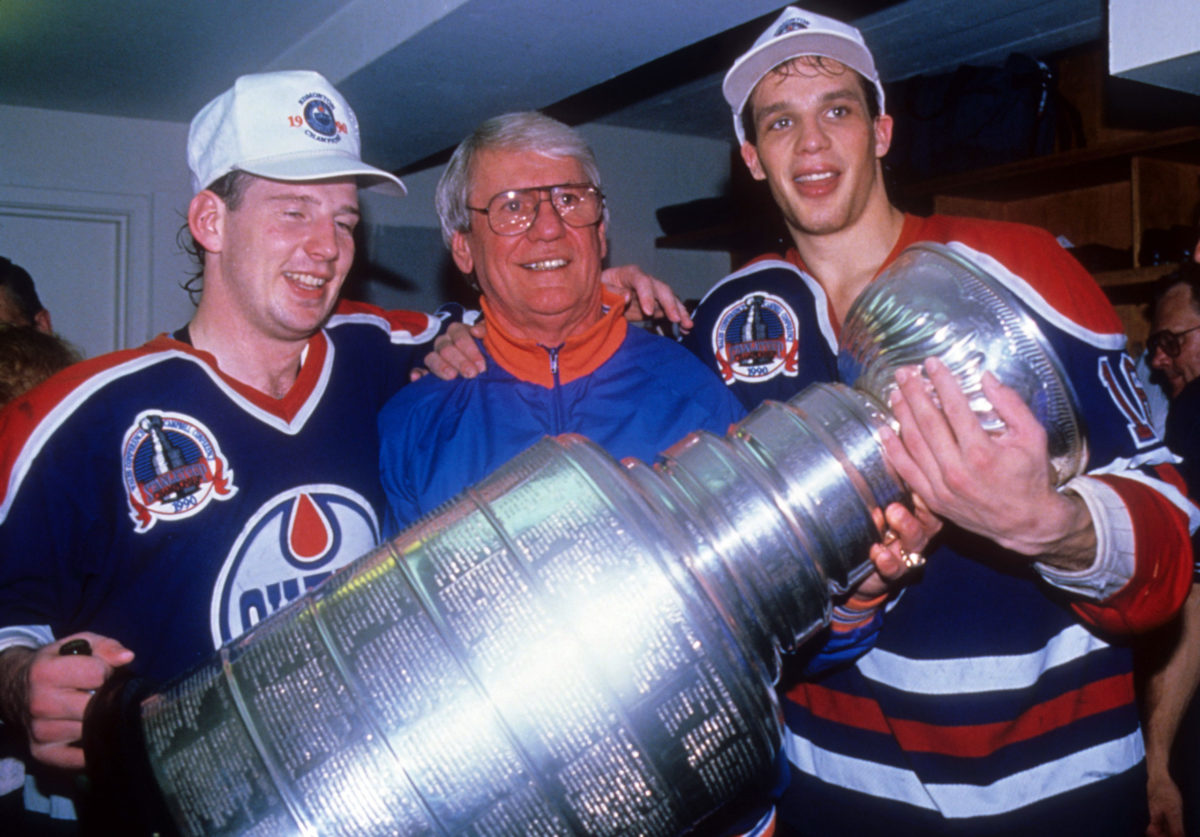
Edmonton became just the seventh team in NHL history to rally from a 3-1 series deficit, eliminating Winnipeg in seven games. Then the Oilers swept aside Gretzky and the Kings in the Smythe Division Final. Edmonton got past the Chicago Blackhawks in six games in the Campbell Conference Final, before dispatching the Bruins in five games to win the Stanley Cup.
All told, the Oilers won 15 of their last 18 games after falling behind 3-1 against Winnipeg. Seven of Edmonton’s 12 wins over the final three rounds came by at least three goals. In the championship series, Edmonton cumulatively outscored Boston 20-8 while holding the Bruins to two or fewer goals in all five of the games.
From being below .500 in November to hoisting the Cup in May, the Oilers made an absolutely incredible turnaround, and, in some way or another, all the players acquired in the Carson trade factored significantly.
Two-Thirds of the Kid Line
Murphy (who was drafted first overall, one pick ahead of Carson, in 1986) and Graves recorded 21 and 25 points, respectively, with the Oilers during the regular season.
Eventually they were slotted alongside Gelinas in what became one of the most famous trios in Oilers history: the “Kid Line.”
Murphy, then 22, scored six times, including the series-winning goal against both Los Angeles and Chicago, and added eight assists in the playoffs. Graves, who turned 22 during the series with Winnipeg, had five goals and six assists in the postseason. Murphy and Graves ranked fifth and sixth, respectively, on the Oilers for even-strength goals during the 1990 Stanley Cup Playoffs.
Gelinas, who at the time was just 19, went from being in and out of the lineup during the regular season to an everyday player in the playoffs. The members of the Kid Line perfectly complemented each other, forming a dynamic trio that Muckler turned to whenever the team needed a spark.
Klima Scores Iconic Goal
In 63 regular-season games with Edmonton, Klima potted 25 goals and dished out 28 assists. His 53 points were the fifth most on the Oilers during the period spanning the Carson trade to the end of the schedule.
The Czech forward’s production dropped in the 1990 Playoffs, as he recorded just five points, all goals, but one of them was perhaps the biggest in franchise history.
Klima, whose effort level wasn’t always to the coach’s satisfaction, was benched for nearly all of sudden death in Game 1 of the Stanley Cup Final. It wasn’t until a few minutes remained in triple overtime that Muckler finally sent the freshest player on his bench out for a shift. Fifteen seconds later, Klima wired the puck past Bruins goalie Andy Moog at 15:13 of the third overtime to give Edmonton a 4-3 win and a 1-0 series lead.
Were it not for Klima’s heroics, there’s no telling how the series would have turned out. To this day, that iconic moment stands as the furthest into overtime that an Oilers player has ever scored.
Sharples Traded for Ruotsalainen
Sharples never played for the Oilers. Upon being traded from Detroit, he was assigned to Edmonton’s American Hockey League (AHL) affiliate, the Cape Breton Oilers. Then on March 6, the date of the trade deadline, he was dealt to the New Jersey Devils for Reijo Ruotsalainen.
An offensive defenceman who could move the puck and quarterback the power play, Ruotsalainen previously played a brief stint with the Oilers when they won their third Stanley Cup in 1987. Sather knew what the Finnish defenceman brought to the table, and it was exactly what Edmonton needed.
Over the final 10 games of the regular season, Ruotsalainen scored a goal and recorded seven assists. He then totalled 13 points in the postseason, including 11 assists, third most among all defencemen in the 1990 Stanley Cup Playoffs.
Combined, Graves, Klima, Murphy and Ruotsalainen totalled 42 goals and 65 assists with the Oilers during the regular season, and 18 goals and 25 assists in 22 playoff games.
What Happened After
Carson never came close to achieving the levels of his first three seasons, topping 50 points just two more times in his NHL career. His last NHL game came in 1995, and he retired from hockey in 1998 when he turned 30.
Likewise, the Oilers have yet to return to the heights of 1990. After Edmonton won its fifth cup, the team was slowly deconstructed, and by 1994, just two players remained from that championship roster.
Ruotsalainen never played in the NHL again, finishing his career in Europe. Graves left Edmonton after signing with the New York Rangers in 1991. In 1993, Murphy was traded to Chicago and Klima was dealt to the Tampa Bay Lightning.
The current Oilers continue to pursue the Cup, and have gotten close, reaching the championship series in 2024 and 2025. Edmonton fans hope that 2027 is the year their favourite team finally reclaims hockey’s holy grail.
The drought currently stands at 36 years and counting, but if Carson hadn’t forced his way out of Edmonton, that drought would likely be closer to four decades.
Free Newsletter
Get Edmonton Oilers coverage delivered to your inbox
In-depth analysis, breaking news, and insider takes - free.
Subscribe Free →