Though he coached the Pittsburgh Penguins for only two seasons, the franchise’s first head coach, George “Red” Sullivan, set the tone for the club from day one. Sullivan died on Jan. 19 at the age of 89 but left a lasting impression on the structure and mindset of future generations of the Penguins organization.
Sullivan’s Road to Pittsburgh
Sullivan, a native of Peterborough, Ontario, broke into the NHL in 1949 with the Boston Bruins, playing just three games with the club that season. Though his first few pro seasons didn’t include many NHL games, he established himself in the American Hockey League (AHL) with the Hershey Bears, setting a league record during the 1953-54 season by scoring 119 points, a record he held for nearly 30 years.
Sullivan joined the Chicago Blackhawks in 1954. He played there for two seasons and was the team’s top scorer in both of them. In 1956, he moved on to the New York Rangers organization, with whom he played the majority of his NHL Career.
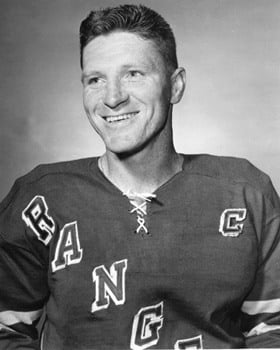
During his time in New York, Sullivan was known for his hard checks, delight in agitating goaltenders and exceptional stickhandling. These traits combined earned him the reputation of an on-ice pest, which led to a fair share of altercations.
The most brutal of these skirmishes occurred during the 1956-57 season in a matchup against the Montreal Canadiens. Tired of Sullivan’s antics, Canadiens defenseman Doug Harvey speared Sullivan in the stomach so hard that his spleen ruptured. The injury was so serious that upon arriving at the hospital, a priest was called to give Sullivan last rites. Despite the initial prognosis, he made a full recovery and played another four seasons with the Rangers before retiring from the NHL.
Sullivan began his NHL coaching career with the Rangers in 1962, succeeding Muzz Patrick, uncle of former Penguins general manager Craig Patrick, midway through the season.
Though the job of Rangers head coach allowed Sullivan to mend fences with former foes like Harvey and Canadiens goaltender Jacques Plante, the actual act of leading a winning team was a bust. In his first three seasons coaching the Rangers, the team finished fifth out of six teams in the league. He was fired after 20 games and a 5-10 record in the 1965-66 season and replaced by Rangers general manager Emile Francis.
Despite being offered a “job for life” with the Rangers organization as the coordinator of player personnel and scouting, Sullivan had the desire to coach, and he didn’t have to wait long for another opportunity to knock.
On May 17, 1966, the Pittsburgh Post-Gazette’s Charley Feeney reported the appointment of the general manager and head coach of Pittsburgh’s newly-formed unnamed National Hockey League club: Jack Riley and Sullivan, respectively.
Of Sullivan’s addition to the franchise, Riley said:
“I never had anybody else in mind. Several other expansion clubs were after Sully. I told [club president] Jack McGregor I wanted him and he said: ‘fine, get him,’” (from ‘NHL Club Springs Surprise’ – Pittsburgh Post-Gazette – 5/17/66).
Though Sullivan’s tenure as head coach was short – just two seasons, both of which ended in next-to-last place finishes in the West Division and exclusion from the Stanley Cup Playoffs – he was instrumental in scouting and assembling the first Penguins squad. He also set standards for conduct on-and off-the-ice, as well as desirable aspects for gameplay.

Sullivan Emphasized Physicality
Sullivan was known as an agitator from his own days playing in the NHL, and that affinity for gritty play carried through to his coaching career. When asked what traits he was looking for in players joining the first Penguins team, Sullivan said:
“Hard checkers. I’m looking for hard checkers. If a player checks hard enough long enough, he’ll always get a chance to put the puck in the net,” (from ‘Red Sullivan Checks Up on the Checkers’ – The Pittsburgh Press – 1/27/67).
Even today, the Penguins value players who can deliver hard, solid checks. Jack Johnson, a hotly-contested addition to the club last summer, has 140 hits on the season, 39 more than the team’s second-place hitter Zach Aston-Reese.
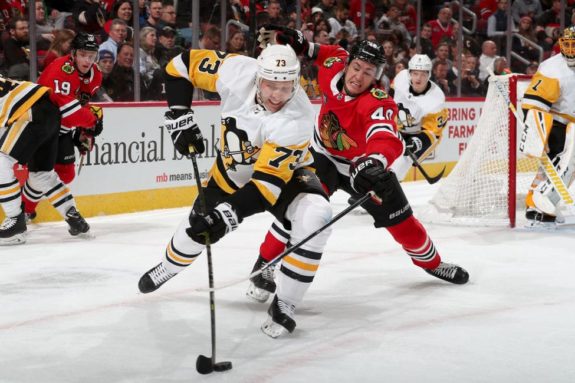
Sullivan did, however, view the line between physicality and goon-like behavior as being thick, dark and solid. Of his physical players, he said:
“Don’t get me wrong, I don’t want hockey players who run completely wild and go around jamming sticks down everyone’s throat… You can’t win too many games with just body-checking. You have to have someone back there who can get the puck and lug it out,” (from ‘Unloved Noel Wonders What Price Glory’ – The Pittsburgh Press – 1/5/68).
This emphasis on a physical, not harmful, style of play is still valued within the Penguins organization. Players like Matt Cooke, Steve Downie and even Brooks Orpik, who had repeat offenses of high hits and dangerous contact, were encouraged by coaches and team management to clean up their acts.
Sullivan Praised Veterans
When crafting the first Penguins squad, Sullivan wasn’t afraid to give veterans the looks they deserved. While youth and longevity are rightfully valued in hockey, and looking for the next wave of greatness is never a bad idea, he knew the worth of a veteran player.
“Some of the older players actually could do us more good than many of the younger ones. You have to have a thinking man’s head out there on the ice… We need the experience for a few seasons, at least, and we need youth, too,” (from ‘“Old” Players Approved By Young Coach Sully’ – Pittsburgh Post-Gazette – 1/21/67).
The Penguins of today place a high value on youth talent, which became most apparent in the choice to protect goaltender Matt Murray in the 2017 Expansion Draft over the more experienced Marc-Andre Fleury. However, the organization still knows that the best performing squads have a mix of old and new talent.
In the late 2000’s, veterans like Gary Roberts, Mark Recchi, and Billy Guerin were brought on board to assist, guide and teach young talents like Sidney Crosby and Evgeni Malkin. Though Crosby and Malkin are in their 30’s now, they’re not considered the oldest veterans on the team. That honor goes to the player everyone calls “Dad,” 42-year-old Matt Cullen, who played a part in the Penguins’ back-to-back Cup victories in 2016 and 2017.

Though his time coaching the Penguins was short, Sullivan’s vision for a physical, disciplined and experience-balanced team has served as a Penguins model for 52 seasons, and will likely live on for many more to come.
Free Newsletter
Get Penguins History coverage delivered to your inbox
In-depth analysis, breaking news, and insider takes - free.
Subscribe Free →