I play recreational ice hockey in Texas, and one thing you see often is a player joining an ice league who mentions he grew up playing roller. They transition to the ice and end up playing a little uniquely, and most people notice. Most will say their game looks different than a traditional ice hockey player’s. So this year, when Jaxon Cover was drafted, his history with roller hockey brought up some interesting questions about how those skills transition. In Texas, some of the better beer league players come from roller hockey. Cover is an NHL draft pick; that gap seems insane.
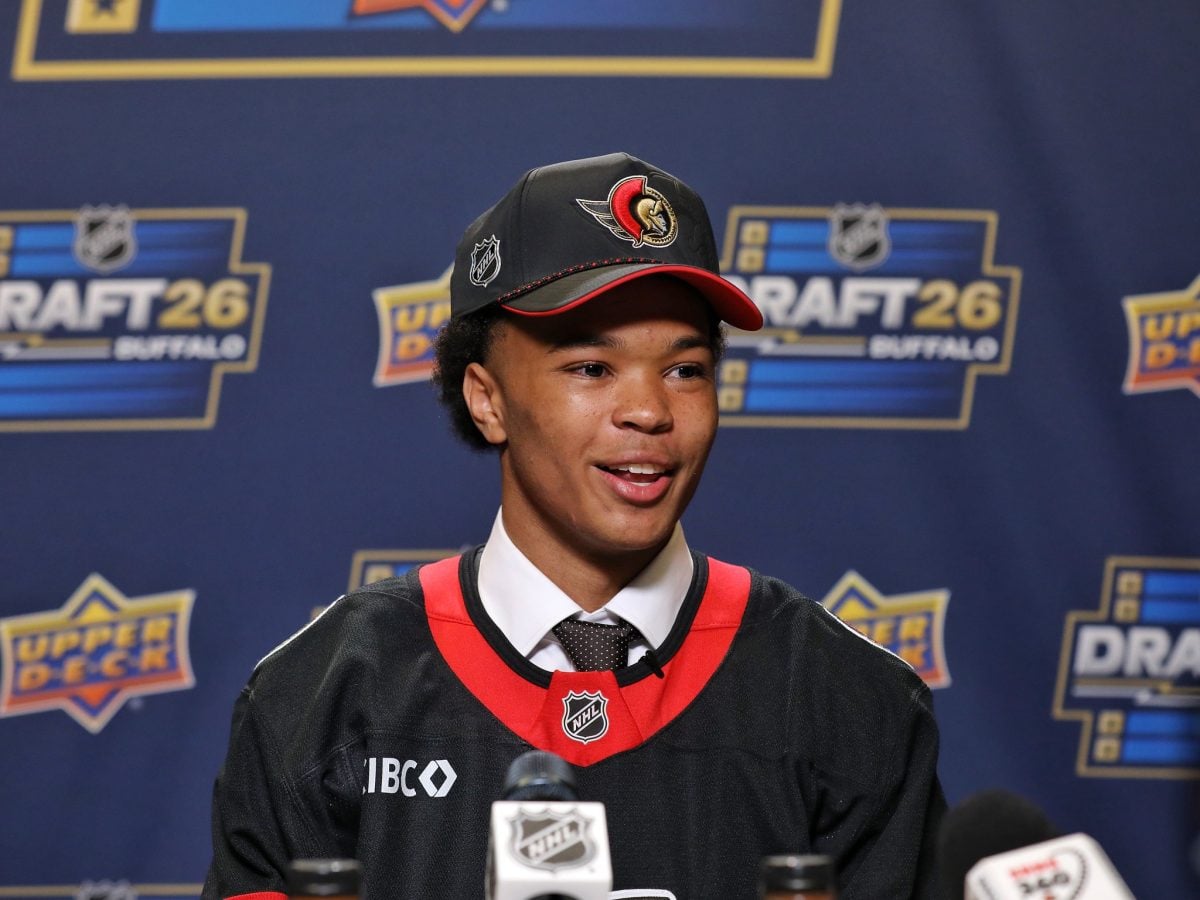
Cover learned the game on the only rink in the Cayman Islands, and he didn’t lace up ice skates for anything serious until he was around 13. Six years later, the Ottawa Senators called his name 32nd overall at the 2026 Draft, the last pick of the first round and the first player from the Cayman Islands ever drafted. It took an unconventional route to get here, and maybe it will make scouts and organizations start looking around the inline rinks. But before we head down to the local inline rink, let’s answer some questions. What does a kid actually build playing roller hockey, what does he still have to build once he steps on the ice, and which of those two buckets is Cover’s game sitting in right now?
Two Sports That Look Alike and Aren’t
Stand a roller hockey game next to an ice hockey game, and you will quickly see there are plenty of similarities. Same stick, same net, same overall game plan. Only three things differ, and those decide what a young player’s body and instincts learn to optimize for.
The first is friction. Wheels grip and a blade glides, so on ice you coast a long way off one push and steer by carving an edge. On wheels you never get that free glide, your turns round off, and you stop with a drag or a T instead of the hard two-foot bite of a hockey stop. A 1987 comparison of skaters found roller and ice strides nearly identical in power and stroke rate, separated mostly by a wider glide-leg angle on wheels, because higher friction changes how you carry speed.
The second is format. Roller is usually four on four on a smaller surface with no offside and no icing, which means more touches, more open space, and constant reading of a live play instead of stoppages. A format that develops where roller players’ hands and vision come from.
The third is contact. Most roller is non-contact, so a roller kid protects the puck with body position and angles rather than by leaning on people, and he never banks the reps of a board battle or a net-front scrum. So it’s not a full picture, but enough you can see that roller players have a certain style if they played in the traditional format. It is hard to explain, but if you ever notice a roller player on the ice, you can tell they play a bit differently.
What Actually Carries Over From Wheels to Ice
When transitioning from roller to ice, the hands come with you. So does the spatial reading, deception, quick release in traffic, and conditioning, because wheels never let you coast. Researchers have measured inline as more taxing than ice at game speeds (note: the research is from the 90s, but it’s still a good baseline). From my reading of the research, I believe the parts that do not specifically translate are the hard stop and the deep edge carve that opens a shooting lane against a set defender (as well as a ton of the small “feel” mechanics of the ice friction on your blades and the puck).
You can see both halves in the players who made the jump. Patrick Maroon, three Stanley Cups deep, credits roller hockey for his hands and his sense and kept playing it into his teens. The Washington Capitals’ Ethen Frank, the fastest skater the American Hockey League (AHL) has ever timed, grew up on roller in Nebraska and did not seriously ice skate until nine or 10. Connor McDavid started on rollerblades in the family basement and points to those one-on-one reps as the root of his skill. For every name like those, plenty of roller standouts never translate. I think it is because wheels teach one half of the game, but you still need to translate those skills to the game of ice hockey. Not everyone is cut out for translating.
How Cover Got Here
Cover was born in Florida and raised in Grand Cayman, where he first put on inline skates at three and grew into a roller prodigy on the island’s lone rink, eventually playing up in the pro division at North American championships. He moved to Canada around 12 to attend St. Andrew’s College north of Toronto and started catching up on ice in a hurry. York-Simcoe Express at U16, then the London Knights, who took him in the fourth round of the 2024 Ontario Hockey League (OHL) Priority Selection and handed him a runway in one of junior hockey’s best development programs.
By his draft year, he had turned into a top-six winger on a loaded London team, and the skills that showed up first were the ones he built on wheels. Roller hockey did not do this on its own. What sets Cover apart is that he took those tools and translated them to a sheet of ice fast enough to go in the first round, and translating them is its own kind of talent. Ottawa was not shy about why it spent the pick. Head amateur scout Don Boyd called him a goal-scorer who checks all the boxes.
The Game Ottawa Drafted
Ottawa spent their pick betting on the roller player, and general manager Steve Staios said as much: that he pushed his scouts toward upside over safe floors after a summer of change that included moving captain Brady Tkachuk. Cover is that bet. He is a creative, high-touch winger, 6-foot-1 and still filling out, who lives in the middle of the ice and makes plays off the half wall. And his production backed it up: roughly 20 goals and 52 points in 67 games as an OHL rookie. His assists have outrun his goals at every stop going back to minor hockey, which is exactly the fingerprint of a player whose vision arrived before his finishing.
Across 37 games, Cover generated 166 shot attempts, and the volume of those shots clustered around where his skill lives, the slot and both circles, with the left circle his busiest spot as a left shot working his forehand off the wall. What is nearly empty is the perimeter, barely a dozen attempts from the point and the low areas combined.
Two other numbers matter more for the projection. Only about 56 percent of his attempts reached the net, the shooting-side tell of a player still learning to change angles with his edges to open a lane. He also logged eight hits across those 37 games. He gets to good ice, and he distributes, but he is not yet winning pucks below the dots or grinding through contact, and that is the roller background showing up in the data.
Where He Fits in Ottawa
All freshly drafted players come with a list of improvements, and these are more of a to-do list than knocking his talent, and Ottawa is set up to wait on it. The Senators’ NHL forward group is fairly full around Tim Stützle, Drake Batherson and Dylan Cozens, so there is no pressure to rush him, and the organization’s recent draft record needed exactly this kind of high-ceiling swing. The plan is another OHL season in London, then Penn State in 2027-28, then a pro runway through Belleville, which puts a realistic NHL arrival three to five years out.
Ottawa is building around skill and pace, and Cover’s creativity, transition speed and power-play instincts point at the kind of player that group wants once the rest of his game catches up. The Senators will ask him to defend and to compete for ice he currently avoids, and that is the swing skill. The thing to track in his sophomore OHL season is not the point total, which will come, but whether more of those attempts start reaching the net and whether he begins to win a few of the battles below the goal line, because that is the line between a skill winger who scores in junior and one who scores in the NHL.
Free Newsletter
Get Ottawa Senators coverage delivered to your inbox
In-depth analysis, breaking news, and insider takes - free.
Subscribe Free →