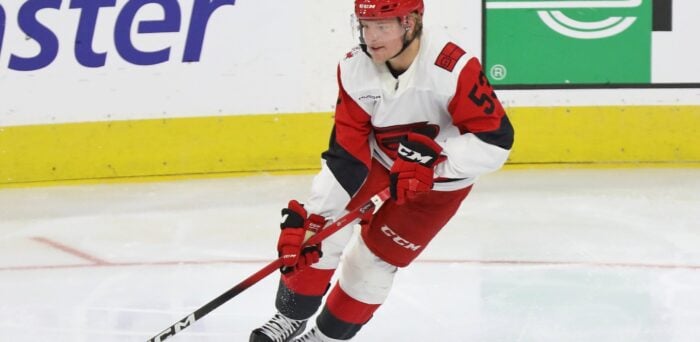
Since returning to the lineup at center against the Philadelphia Flyers, Jesperi Kotkaniemi has looked rejuvenated. On the five-game road trip that took place while the North Carolina State Fair was on outside the Lenovo Center, the Finn recorded three goals and an assist. He’s up to three goals and three assists for six points in 11 games this season. The only real blot so far is that he’s only winning 42% of his faceoffs. That’s the Hurricanes’ extra forward. The lingering question is pretty simple: how do you move a guy performing like this back to the press box?
Make no mistake: this is a headache organizations love. They’d rather have too many players performing well than not enough. That doesn’t provide a sudden solution here. Mark Jankowski and Jordan Staal formed the backbone of the bottom six that just won the Stanley Cup. That said, past success doesn’t predict future success. So, what’s the best path forward?
Kotkaniemi as a Center
We have to separate this season from Kotkaniemi a little. He returned to the fold in the third game, replacing Nicolas Deslauriers, who started slowly. Kotkaniemi started the season as a winger. He came in, and the Hurricanes started winning. We can argue causation versus correlation, but Carolina rarely changes a winning formula. However, that changed on Oct. 11, when Staal tore his calf before the second game against the Philadelphia Flyers and the Hurricanes had to move Kotkaniemi back to center.
Since then, Kotkaniemi has looked at his best, with three goals and an assist in the past seven games. Four points in seven games is roughly a 48-point pace over the new 84-game schedule. He’s also has a plus 5rating, for those who like that stat. That might not seem impressive, but Kotkaniemi is averaging 13:42 a night, which means he’s doing this from a bottom-six role. He’s taken this opportunity and played very well.
Seven games is a small sample size, but Kotkaniemi has a 43-point season under his belt in Carolina. He can produce in this system. The issue has always been consistency offensively. In his current role with the team, Kotkaniemi isn’t being asked to produce. The Hurricanes want him to be a difference-maker defensively, and he looks rejuvenated on both ends of the ice playing that role.

Since moving to center, Kotkaniemi has a 5-on-5 goals-for rate (GF/60) of 5.13, according to Natural Stat Trick. His goals-against rate (GA/60) is 0.73. That gives him an 87.50% goals-for percentage (GF%). It’s only seven games, but that is the level of performance the Hurricanes have been desperate to get out of the Finn. His expected goals totals aren’t as preposterous: an expected goals-for rate (xGF/60) of 2.67 and an expected goals-against rate (xGA/60) of 1.84, but that’s still good. His expected goals-for percentage (xGF%) is “only” 59.17%, but that’s still a high level of performance.
For reference, Kotkaniemi had vastly inferior stats as a winger. His xGF/60 was 2.40, and his xGA/60 was 1.45. That’s fine; it yields a 62.31% xGF%. That’s not what’s inferior. As a winger, his GF/60 and GA/60 were both 4.20, meaning a GF% of 50%. That’s the vast difference the Hurricanes have seen from Kotkaniemi’s lines depending on his position, in an admittedly small sample size. Kotkaniemi isn’t the same player on the wing, so playing him there is doable when injuries hit, but not if the Hurricanes want the best from him.
A Healthy Roster Conundrum
Statistically, Kotkaniemi and his lines seem to perform better at center than with him on the wing. Again, we can argue causation or correlation, but that’s what the numbers suggest. The interesting questions begin when we look ahead. At some point in the next two-to-six weeks, Carolina will have the three players currently out back in the lineup. So the inevitable question is: what happens then?
Kotkaniemi played only 43 games last season and didn’t get near the ice in the playoffs. He usually sits in the press box. Staal will return to that role when he’s healthy. The reigning Conn Smythe winner and Carolina captain isn’t fighting for a roster spot; he’s earned it. That leaves Jankowski. He’s closer to returning than Staal, but he doesn’t necessarily have to replace Kotkaniemi.
Jankowski has spent a lot of time as a left winger. Simply swapping Kotkaniemi and Jankowski would let Kotkaniemi stay in the position he’s starting to make his own while reacclimatising Jankowski to the roster. It would also give Carolina an extra faceoff option down the lineup, which is perhaps the one thing the Hurricanes’ fourth line lacks when it’s healthy.
The issue is that it again rearranges the fourth line. It doesn’t solve the problem; it just moves it as it would displace one of the wingers. Most of the Hurricanes’ wingers have special-teams responsibilities, which Kotkaniemi doesn’t, so that creates issues here, too. It’s justifiable, but it’s not the cleanest solution either. The Hurricanes don’t have an obvious solution here. A desirable problem for coaches is a problem nonetheless.
Ultimately, the Hurricanes are in a position they’ll adore. So many players are playing well that they have difficult decisions to make about who plays. That’s exactly what coaches want. The tradeoff is that players want to be rewarded for playing well, either by staying in the lineup or taking on more responsibility. That’s where it shifts from Kotkaniemi to the coaching staff. They’ve got a decision to make here. Does the weight of championship pedigree outweigh recent performance? That’s the question ahead as the Hurricanes get healthier.
Free Newsletter
Get Carolina Hurricanes coverage delivered to your inbox
In-depth analysis, breaking news, and insider takes - free.
Subscribe Free →