The start of the Stanley Cup defense hasn’t been what the Carolina Hurricanes wanted. Several issues have emerged in the opening games, but perhaps the most underrated part of the Hurricanes’ struggles is Alexander Nikishin’s absence. This isn’t to say that Charles Alexis Legault or Mike Reilly, who have replaced him in the lineup, are bad. Nikishin was an NHL All-Rookie Team defenseman and a Stanley Cup champion. His absence seems to have affected the team more than some thought.
What Carolina Is Missing
You cannot approach Nikishin’s absence as simply a loss of his base production. Yes, the Hurricanes failed to replace his 11 goals and 22 assists from the blue line. That does not tell the whole story. Nikishin’s importance wasn’t his production; it was the dominant matchup he created lower down the lineup.
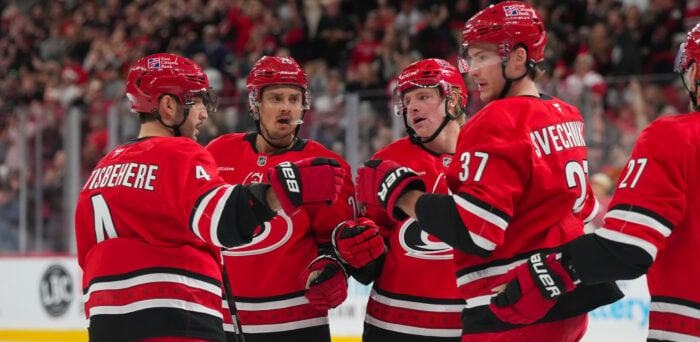
Nikishin’s most common partner last season was Shayne Gostisbehere. Together, Nikishin and Gostisbehere formed a pairing very few teams could contain. As Carolina’s third pairing, it created a matchup nightmare. Carolina’s deployment of this unit almost sheltered them, even though they were fully capable of playing against anyone. With friendlier line matchups, they could run riot.
According to MoneyPuck, the Gostisbehere-Nikishin pairing had an expected goals percentage (xGF%) of 59%. That essentially means the Hurricanes had almost a 60-40 split in expected goals in their favor with this pairing on the ice. On many teams, you could justify this as a top pairing, and Carolina was rolling it out as the bottom pairing. That created a talent mismatch. Both Nikishin and Gostisbehere can put pressure on opponents individually, but together, they went nuts. They had an expected goals for (xGF) total of 19 as a pairing in just 322 minutes. That’s an expected goals for per 60 (xGF/60) of 3.53, well above the rest of the blue line core.
If we isolate Nikishin’s 5-on-5 numbers, you can see what the Hurricanes are missing. Nikishin had a xGF/60 of 3.25. When you look at his heavy shot, which sits above 90 miles per hour while coming from the third pairing, he was a true luxury for the Hurricanes. Teams had to account for that pairing because they could impact and change games as well as anyone else on the roster.
Replacing the Irreplaceable
Nikishin is somewhat of a unicorn. He’s unique in what he brings, so replacing everything he offers was never viable, but the biggest miss has been the offensive pressure he created. It’s too soon in the season to say whether the Hurricanes must address this, but after three games, his absence appears to have a bigger impact than many anticipated.
Look at the combination of last season and the first few games of this season; Legault’s performances highlight the difference offensively. His xGF/60 is just 2.35 at 5-on-5 across his entire NHL career, according to Natural Stat Trick. That’s fine for a third-pairing defenseman, but fine isn’t what the Hurricanes had. Nikishin and Gostisbehere were one of the best offensive pairings in the NHL, with the third-highest xGF among defense pairings that played 300 minutes. For a third pair, that is an extremely strong output.
This doesn’t begin to account for the size and strength of the defenseman, the leadership Nikishin brought as the former SKA St. Petersburg captain, or the experience he got as one of the best defensemen in the Kontinental Hockey League (KHL). It doesn’t account for Nikishin’s Stanley Cup-winning experience or the ice time he got higher up the lineup because of all the blue line injuries. The Hurricanes were never going to find someone who offered all of that in one position.
Absence Impact
This lack of blue line offense isn’t the biggest issue, but it feels like it’s under a microscope, especially with the forwards failing to do their part. Carolina’s system is unique to the extreme. It relies heavily on shots from the blue line, with forwards tasked with getting into position for deflections and rebound chances. In 2025-26, their 627 long-range shots (shots above the face-off circles) were the second-most in the NHL, according to NHL Edge. The Hurricanes can’t replace that ability to get the puck to the net right now.
Now, as general manager (GM) Eric Tulsky loves to say, this could change with one phone call. One call to another GM could bring in a new skill set; one call to Nikishin’s new agent could seek to mend the burned bridges. That doesn’t help the current situation. There is no clean-cut solution. The Hurricanes will hope this problem fixes itself as they work through their struggles. Still, if it doesn’t, Nikishin’s lingering impact may prove substantially more important than initially thought.
Free Newsletter
Get Carolina Hurricanes coverage delivered to your inbox
In-depth analysis, breaking news, and insider takes - free.
Subscribe Free →