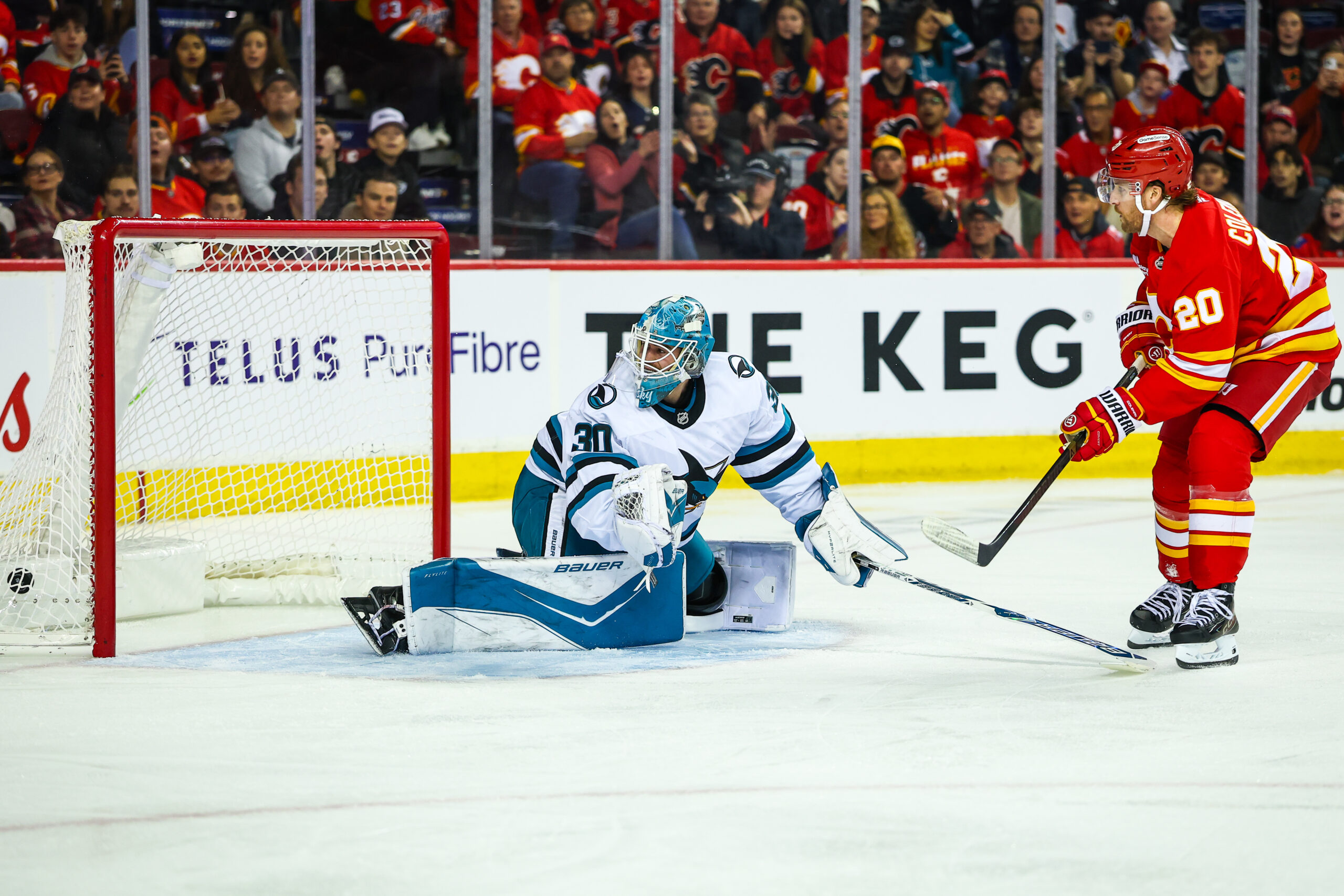
Early in the third period Saturday against the Detroit Red Wings, Ivar Stenberg one-timed a Macklin Celebrini feed past John Gibson, and the San Jose Sharks led 3-1. They had outplayed Detroit for long stretches, Celebrini was in the middle of a three-point night, and they were in a position to close out the game.
Twelve minutes later, it was tied. A shootout later, it was a loss. For the fourth time in eight games, the Sharks coughed up a two-goal third-period lead, and for the first time, it cost them the win outright.
That is the line that should worry San Jose. The first three times this happened, the Sharks escaped, two overtime wins to open the season and a shootout survival against the Nashville Predators. The margin for that kind of luck is thin, and it ran out in Detroit. The pattern is no longer a quirk buried inside victories. It is now directly subtracting points from a team that cannot afford to leave them on the ice. They already lost back-to-back games against the Edmonton Oilers and the Boston Bruins.
Now with the Detroit loss, the numbers are stark. Through the first seven games, opponents outscored the Sharks 12-5 in the third period, and San Jose had not won a single final frame. Eight games in, they are one of only two teams in the league without a regulation win, and the other, the Los Angeles Kings, has played two fewer games. The Sharks are 4-3-1, which flatters a team that keeps giving up leads in the last 20 minutes.
It Is Not the Goaltending
The easy explanation would be goaltending, and it does not hold up. Alex Nedeljkovic made 25 saves against Detroit and finished with a 2.78 goals-against average against an expected 2.77, per Natural Stat Trick. He was almost exactly as good as he needed to be. The Emmitt Finnie goal that made it 3-2 and the Alex DeBrincat goal that tied it late were not soft. A team should be able to protect two-goal leads without needing its goaltender to steal games, and on Saturday the goaltending was not the problem.
The breakdowns were structural and individual. Dmitry Orlov, to his credit, said so plainly after the game, taking responsibility for the Finnie goal that cracked the door open. “I think we lost because of me on the second goal,” Orlov said, explaining that he hesitated on a rolling puck rather than closing on Finnie in the slot. It was an honest accounting of exactly the kind of lapse that keeps happening: a veteran defenseman a half-second slow to a dangerous spot, and the puck in the net.
The Coach Says It Is Not Passivity
Here is where it gets interesting, because head coach Ryan Warsofsky does not accept the most common diagnosis. The instinctive read on a team that repeatedly blows late leads is that it sits back, stops forechecking, and invites pressure. Warsofsky rejected that outright.
“I didn’t think we were sitting back,” he said. “That second goal, we make a tough read there in the neutral zone. Third one, obviously goes off when he skates and goes right to him, so that’s kind of unfortunate. But it doesn’t feel like we’re sitting back. We’re still getting some opportunities. We’re pushing forward.”
He is partly right, and that is what makes this hard to fix. The Sharks were not hemmed in their own zone clinging to the lead in Detroit the way they were against the Kings. They kept generating. But Warsofsky’s own words gave the real tell. “We’re saying the right things, for whatever reason. This has kind of gone on here for a little bit.”

A coach who insists his team is not sitting back, yet admits the collapses keep coming, is describing a problem that lives in the details rather than the effort, the tough neutral-zone read, the unlucky bounce, the half-beat of hesitation. Those are harder to coach out than simple passivity, because the players believe they are doing it right.
Why It Matters More Than the Record
The temptation is to shrug this off as a young team learning to close, and there is truth in that. The Sharks are among the league’s youngest rosters, and this is the exact flaw that sank them a year ago, when inexperience and a thin blue line turned third periods into disasters and left them four points short of the playoffs. The personnel is better now. Jacob Trouba, Darnell Nurse, and Michael Kesselring were brought in precisely to add the late-game steadiness the roster lacked. Eight games in, that steadiness has not shown up when it matters most.
San Jose sits fourth in the Pacific at nine points, within touching distance of a playoff spot the organization genuinely expects to chase this season. The difference between a 4-3-1 start and a 6-1-1 one is almost entirely those third periods. The Sharks are good enough to build leads against good teams. Until they learn to keep them, every encouraging sign comes with the same asterisk, and the points they are bleeding in the final minutes are the ones that decide October and, eventually, spring.
Free Newsletter
Get San Jose Sharks coverage delivered to your inbox
In-depth analysis, breaking news, and insider takes - free.
Subscribe Free →