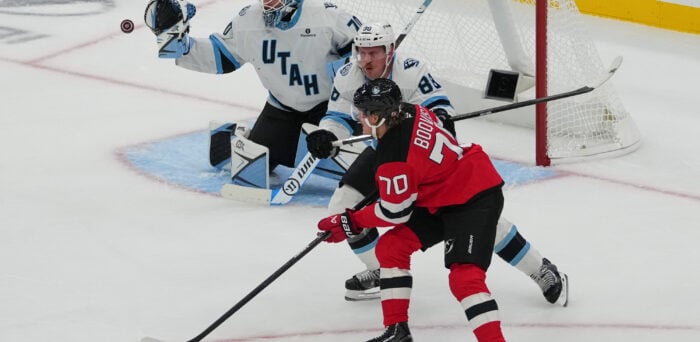
The New Jersey Devils enter the 2026-27 season with a roster that has more depth than the one that finished outside the Stanley Cup Playoffs last season. New general manager Sunny Mehta made it a priority to add depth this offseason, bringing in strong forwards like Anthony Mantha, Evan Rodrigues, and Luke Evangelista while also giving several younger players a chance to push for an NHL roster spot.
The result was a training camp with 57 players — 33 forwards, 18 defensemen and six goaltenders — all competing for a spot in the lineup, which has created an interesting situation for several returning Devils. Some players are firmly entrenched in New Jersey’s plans. Others have enough upside, experience or contractual security that their roster spots are relatively safe. Then there is a group entering the season with something much more significant to prove.
Three Devils, in particular, have a crucial opportunity to establish — or re-establish — themselves before the organization is forced to make decisions about their long-term futures. With younger players pushing from below and increased competition throughout the roster, Nico Daws, Stefan Noesen and Dawson Mercer may not have many more opportunities to make their case. Can they prove they belong in New Jersey’s long-term plans?
Nico Daws
This season marks the clearest opportunity of Daws’ NHL career. The 25-year-old goaltender has spent the past four seasons moving between New Jersey and the Devils’ AHL affiliate, Utica Comets, waiting for an opportunity to establish himself as a full-time NHL goaltender.
That opportunity opened up this summer when the Devils traded Jacob Markstrom to the Florida Panthers, creating a vacancy alongside veteran netminder Jake Allen. New Jersey then signed Daws to a two-year contract extension on July 1, giving him a chance to compete for a more permanent role against Allen and newcomer David Rittich.
After the first few practice sessions of training camp, Mehta addressed the media about Daws and the Devils’ overall goaltending situation. While he expressed confidence in the group, he also made it clear that Daws must make the most of his chance.
“I’m very comfortable with our goaltending,” Mehta said. “[Daws has] got a path in front of him right now. And, as I’ve told him, it’s going to be up to him to decide what to do with that opportunity. But the opportunity’s there.”
Daws got his first opportunity in the Devils’ 3-2 preseason victory over the New York Rangers on Monday. While he seemed to be finding his footing, he stopped 13 of the 15 shots over the two periods he played, finishing the night with an .867 save percentage.

That might not be a great number, but Daws showed flashes of the athleticism and composure that have kept him in the team’s plans. He made several strong saves, including two on notably high-danger chances, helping New Jersey maintain its lead and ultimately secure the victory.
It was not a perfect first showing, but Daws should get another chance, with two preseason games remaining, to build momentum and show the coaching staff he can be trusted with a heavier workload. There is also reason to believe he can handle that opportunity.
In his limited NHL appearances over the past two seasons, Daws posted a .908 save percentage in three games last season and a .939 save percentage in six appearances in 2024-25, showing that he can put together strong performances when given the chance.
However, he now needs to prove he can do it consistently. With Allen’s NHL experience and Rittich competing for a spot, Daws cannot afford to rely on his potential. He needs to turn this opportunity into tangible results and make it impossible for New Jersey to look elsewhere.
Stefan Noesen
Noesen’s situation is unique. He has already proven himself a valuable contributor for the Devils. After returning to the team ahead of the 2024-25 season, the veteran winger put together the best offensive season of his NHL career, recording 41 points (22 goals, 19 assists) in 78 games.
His ability to establish himself in front of the net, create havoc around the crease and contribute on the power play made him a reliable secondary scoring option for New Jersey. Last season, however, was a significant step in the opposite direction.
Injuries limited Noesen to 38 games, and even before he was sidelined in January, his production was inconsistent. He recorded only seven points during his shortened campaign, leaving plenty of questions about what his role would look like moving forward. Now, the 33-year-old is entering the final year of his contract.
Noesen entered training camp with plenty working in his favor. He has experience with the Devils’ system, understands what the organization expects from him and has already shown he can produce at the NHL level. Perhaps most importantly, his physicality and net-front presence provide elements that not every forward on the roster can replicate.
At the same time, his path to a consistent spot in the lineup is less certain than it was a year ago. Management added legitimate NHL-caliber depth to their forward group, with Mantha, Rodrigues, Evangelista and Jesper Boqvist all vying for opportunities, meaning Noesen is facing a higher level of competition for ice time than last season.
He needs to show he can stay healthy while providing a consistent, physical, productive game that made him so effective during the 2024-25 season. If he can do that, his net-front ability and special teams contributions could make him an important piece of New Jersey’s bottom six.
But if injuries continue to limit him or his production fails to return, the Devils now have enough organizational depth to consider other options. This season is ultimately about proving that 2025-26 was an injury-plagued setback rather than the beginning of a larger decline. It’s time for Noesen to show he still has an important role to play in New Jersey.
Dawson Mercer
Mercer’s situation is perhaps the most complicated of the three. Unlike Daws and Noesen, the 24-year-old forward is not fighting to prove he belongs in the NHL. He has already established himself as a reliable and durable member of the lineup, appearing in more than 400 NHL games and building a reputation for his versatility.
Last season was another example of that consistency. Mercer recorded 42 points (20 goals, 22 assists) in 82 games, extending his streak of consecutive games played to five full seasons. He also ranks fifth among active NHL players in consecutive games played. On the surface, there is little to criticize about a 24-year-old forward who has remained healthy and consistently contributed at the NHL level.
The question is whether he can become more than a reliable 40-point player. His 42 points tied the second-highest total of his career, and he has yet to replicate the 56-point season he recorded in 2022-23. At the same time, his versatility has made it somewhat difficult to define exactly where he fits in New Jersey’s lineup.

He can play both center and wing and is capable of taking on different responsibilities, but the Devils still need to determine whether he is a long-term top-six forward or better suited to a bottom-six role. He spent much of last season alongside Nico Hischier and Timo Meier, a trio that New Jersey has continued to view as a potential top line. With additional talent now entering the forward group, however, Mercer’s place is no longer set.
That does not mean he is fighting to remain on the roster. Instead, he is fighting to establish a defined role. His contract situation adds another layer to that question, with one year remaining on a three-year, $12 million deal. The Devils will have to make a decision about his future following this season.
A resurgent offensive campaign would make that decision considerably easier. If Mercer can take another step offensively and establish himself as a consistent top-six contributor, he would strengthen his case to remain a significant part of the team’s long-term plans.
If he remains around the 40-point mark without demonstrating additional offensive growth, however, the Devils may have to weigh his durability and versatility against younger or more productive options emerging throughout the organization.
This season is not about proving that he belongs in New Jersey. He has already done that. It is about proving that he can become an even more impactful piece of the Devils’ long-term core, and showing the organization exactly what kind of role he can fill moving forward.
Competition Increasing
The Devils are no longer a team simply trying to fill out a roster. Mehta has spent the offseason adding significant depth pieces throughout the lineup to provide internal competition. They are investing in players they believe can become meaningful pieces of their future, while creating an increasingly competitive environment for returning players.
Daws, Noesen and Mercer are not out of the Devils’ plans after this season. Their situations are all different, and each has a legitimate case for remaining a valuable part of the team’s roster moving forward. But New Jersey has made one thing clear through its offseason moves: roster spots and roles have to be earned. These three players now have the opportunity to do exactly that.
Free Newsletter
Get New Jersey Devils coverage delivered to your inbox
In-depth analysis, breaking news, and insider takes - free.
Subscribe Free →