- Problem One: Who Slots In as the Maple Leafs’ Second-Line Centre?
- Problem Two: Free Agency Options Are Limited at the Centre Spot
- Problem Three: Losing Tavares Is Not Just the Numbers — It’s the Stability
- Problem Four: Without Tavares, the Forward Core Must Be Redefined
- What’s Next for the Maple Leafs?
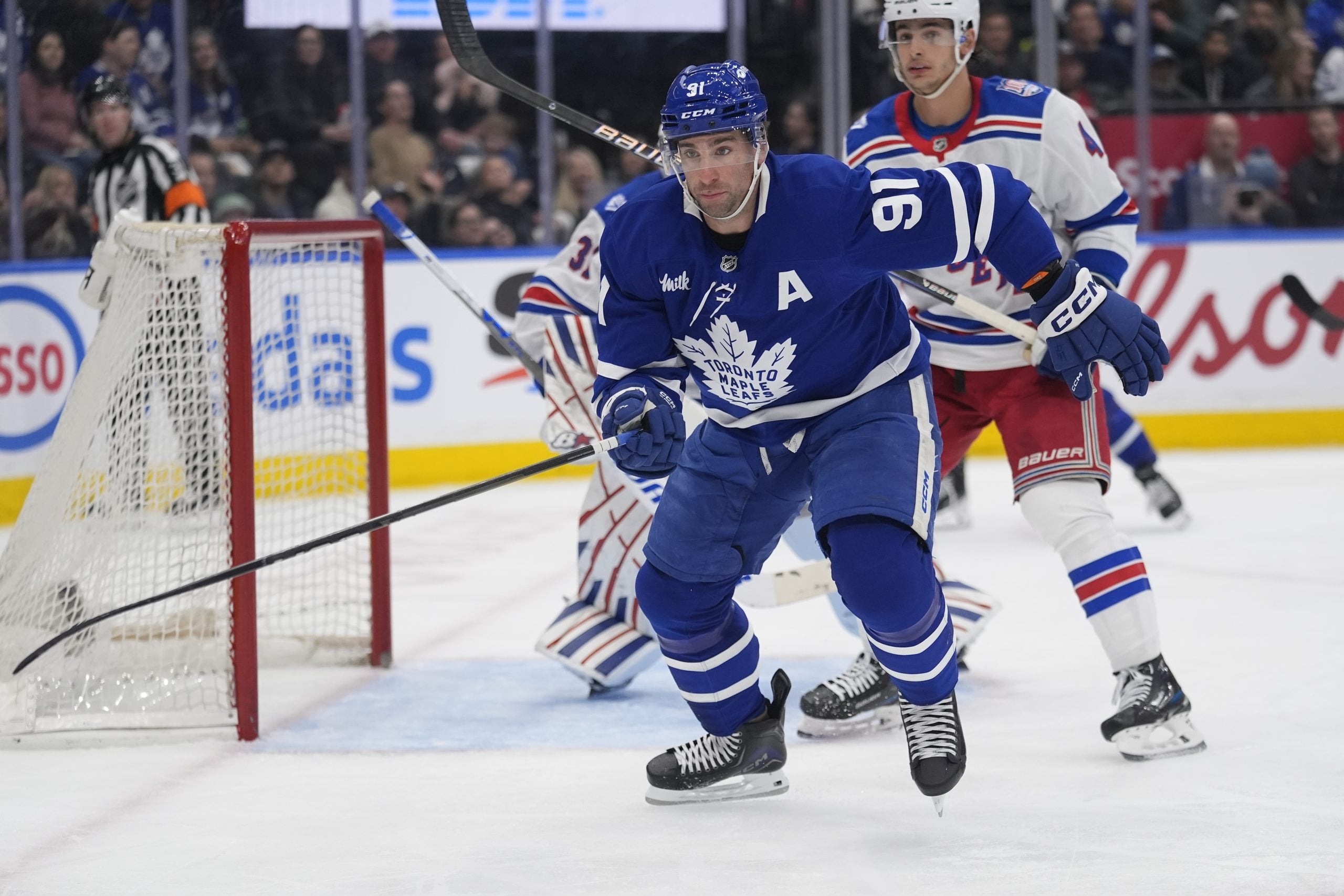
As speculation swirls around the Toronto Maple Leafs‘ Mitch Marner’s future, another storyline should get more attention. There is a chance that former captain John Tavares could depart. While many assume he’ll sign an extension at a lower cap hit to finish his career in Toronto, what if he doesn’t?
Few analysts seem to be asking that question, but they should. Because if Tavares isn’t on the roster next season, the Maple Leafs will be staring down a massive hole without an easy solution. There’s a tendency to take the future Hall of Famer for granted. However, losing him would create four problems.
Problem One: Who Slots In as the Maple Leafs’ Second-Line Centre?
Auston Matthews is the team’s No. 1 centre, but the depth chart behind him thins out quickly. Without Tavares, the Maple Leafs would likely be looking at Max Domi, Scott Laughton, or David Kämpf (if he even is around at the beginning of the season) to step into the second-line role. None of those three has consistently proven they can carry that responsibility over an 82-game season and into the playoffs.
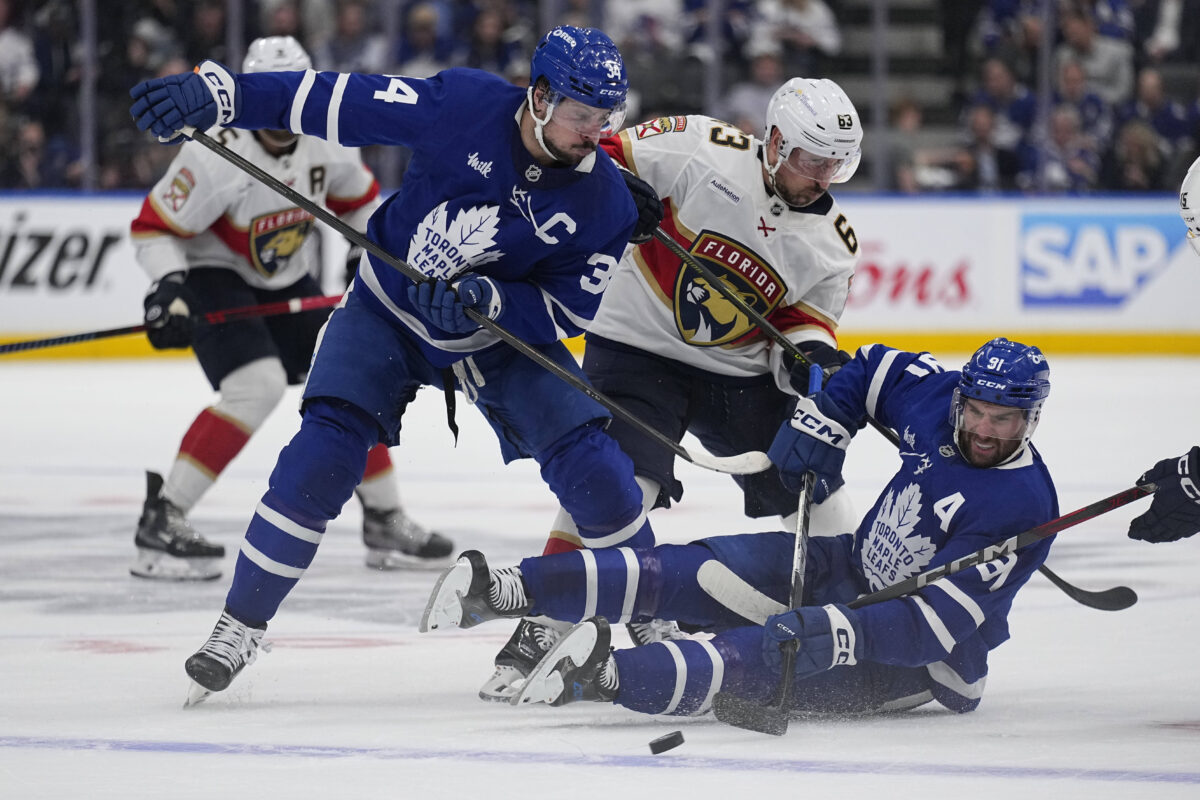
It’s not just a question of offensive production. Even at age 33, Tavares still put up 74 points (38 goals and 36 assists) in 75 games. He’s also one of Toronto’s most reliable faceoff men and is an under-valued net-front presence. Remove him, and the ripple effect begins: Domi moves up the lineup, weakening the third line. Kämpf’s usage expands beyond his ceiling, and a gaping hole in the power play and leadership group opens up.
Problem Two: Free Agency Options Are Limited at the Centre Spot
The natural assumption is that losing Tavares would free up $11 million in cap space—enough to make a splash. But the unrestricted free agent (UFA) centre market this summer is underwhelming. There’s no clear second-line pivot available without significant overpayment. Players like Matt Duchene and Mikael Granlund are all solid, experienced options—but none bring the kind of impact or presence that would truly excite as a replacement for Tavares. They offer reliability, not inspiration. Other options will likely command big dollars and term, which is something Toronto should be hesitant to commit to after previous mistakes.
This could force the Maple Leafs into pursuing a trade, hoping to acquire a younger, cost-controlled centre who hasn’t yet broken out. That’s a gamble. The team would be betting on upside while risking a significant regression in offensive consistency and on-ice leadership. And that’s assuming they can find a willing partner—top-six centres rarely hit the market without a steep acquisition cost. Will the team be sorry it gave up on Fraser Minten too early and moved him to Boston?
Problem Three: Losing Tavares Is Not Just the Numbers — It’s the Stability
Tavares’s impact goes beyond the points he puts up. He’s a stabilizing force in a locker room filled with high-profile personalities. If Marner and Tavares walk in the same offseason, the Maple Leafs would lose two key pillars of their identity, leaving Matthews and William Nylander to carry the load as the remaining members of the Core Four. That’s a heavy reset for a team trying to build a culture under new head coach Craig Berube.

(Jess Starr/The Hockey Writers)
Losing Tavares and Marner raises more profound questions: Who leads this team in challenging moments? Who sets the tone on and off the ice? Leadership, especially in the playoffs, is rarely something you can buy on July 1. That kind of presence often takes years to cultivate.
Problem Four: Without Tavares, the Forward Core Must Be Redefined
Removing Tavares from the equation isn’t just a cap move—it’s a structural shift. The core problem for the Maple Leafs’ top six is the risk of offensive imbalance and instability. Without Tavares, the team would likely lose its ability to run two consistent scoring lines, shifting pressure heavily onto Matthews and creating a top-heavy lineup that’s easier to defend in the playoffs.
It threatens the structure that allows Toronto to roll multiple threats and forces a rebuild of chemistry, depth, and role clarity all at once. The Maple Leafs would be moving from a two-line scoring model to one that risks imbalance unless carefully managed. It would force the front office to be bold and lucky, something Toronto hasn’t always been able to do.
What’s Next for the Maple Leafs?
Not re-signing Tavares risks moving on too quickly. While slower than he was, he remains a point-a-game producer. That’s valuable production, especially from a player willing to step down to a lesser role if it helps the team. A short-term extension at a more team-friendly average annual value (AAV) might be the best bridge to a new era that allows Toronto to transition without tearing down its forward foundation in one summer.
If Tavares stays, he offers continuity, leadership, and stability during what could be a turbulent offseason. If he walks—or the team decides not to re-sign him—they’ll need to replace far more than just some numbers on a stat line. The front office will be forced to confront who they’re letting go and what kind of team they’re trying to become.
Free Newsletter
Get Toronto Maple Leafs coverage delivered to your inbox
In-depth analysis, breaking news, and insider takes - free.
Subscribe Free →